
The Way, the Truth and the Life (Good Friday Worship Service)
Abridged Worship Provided By: Rev. Jacob Shaw (Please note that this is not a verbatim account of our Sunday morning worship, but rather a condensed version for those at home to study and enjoy)
Opening Prayer:
Merciful and sovereign God, on this solemn day we stand before the mystery of the cross. Your Son Jesus entered the garden knowing all that would come upon Him. Open our hearts to the depth of your love shown in Christ’s suffering and death. Silence our distractions, humble our pride, and fix our gaze on Jesus, lifted up that we might have life in His name. Through Him who loved us and gave himself for us, we pray. Amen.
Scripture Reading: John 18:1 – 19:30
When he had finished praying, Jesus left with his disciples and crossed the Kidron Valley. On the other side there was a garden, and he and his disciples went into it.
Now Judas, who betrayed him, knew the place, because Jesus had often met there with his disciples. So Judas came to the garden, guiding a detachment of soldiers and some officials from the chief priests and the Pharisees. They were carrying torches, lanterns and weapons.
Jesus, knowing all that was going to happen to him, went out and asked them, “Who is it you want?”
“Jesus of Nazareth,” they replied.
“I am he,” Jesus said. (And Judas the traitor was standing there with them.) When Jesus said, “I am he,” they drew back and fell to the ground.
Again he asked them, “Who is it you want?”
“Jesus of Nazareth,” they said.
Jesus answered, “I told you that I am he. If you are looking for me, then let these men go.” This happened so that the words he had spoken would be fulfilled: “I have not lost one of those you gave me.”
Then Simon Peter, who had a sword, drew it and struck the high priest’s servant, cutting off his right ear. (The servant’s name was Malchus.)
Jesus commanded Peter, “Put your sword away! Shall I not drink the cup the Father has given me?”
Then the detachment of soldiers with its commander and the Jewish officials arrested Jesus. They bound him and brought him first to Annas, who was the father-in-law of Caiaphas, the high priest that year. Caiaphas was the one who had advised the Jewish leaders that it would be good if one man died for the people.
Peter’s First Denial
Simon Peter and another disciple were following Jesus. Because this disciple was known to the high priest, he went with Jesus into the high priest’s courtyard, but Peter had to wait outside at the door. The other disciple, who was known to the high priest, came back, spoke to the servant girl on duty there and brought Peter in.
“You aren’t one of this man’s disciples too, are you?” she asked Peter.
He replied, “I am not.”
It was cold, and the servants and officials stood around a fire they had made to keep warm. Peter also was standing with them, warming himself.
The High Priest Questions Jesus
Meanwhile, the high priest questioned Jesus about his disciples and his teaching.
“I have spoken openly to the world,” Jesus replied. “I always taught in synagogues or at the temple, where all the Jews come together. I said nothing in secret. Why question me? Ask those who heard me. Surely they know what I said.”
When Jesus said this, one of the officials nearby slapped him in the face. “Is this the way you answer the high priest?” he demanded.
“If I said something wrong,” Jesus replied, “testify as to what is wrong. But if I spoke the truth, why did you strike me?” Then Annas sent him bound to Caiaphas the high priest.
Peter’s Second and Third Denials
Meanwhile, Simon Peter was still standing there warming himself. So they asked him, “You aren’t one of his disciples too, are you?”
He denied it, saying, “I am not.”
One of the high priest’s servants, a relative of the man whose ear Peter had cut off, challenged him, “Didn’t I see you with him in the garden?” Again Peter denied it, and at that moment a rooster began to crow.
Jesus Before Pilate
Then the Jewish leaders took Jesus from Caiaphas to the palace of the Roman governor. By now it was early morning, and to avoid ceremonial uncleanness they did not enter the palace, because they wanted to be able to eat the Passover.
So Pilate came out to them and asked, “What charges are you bringing against this man?”
“If he were not a criminal,” they replied, “we would not have handed him over to you.”
Pilate said, “Take him yourselves and judge him by your own law.”
“But we have no right to execute anyone,” they objected. This took place to fulfill what Jesus had said about the kind of death he was going to die.
Pilate then went back inside the palace, summoned Jesus and asked him, “Are you the king of the Jews?”
“Is that your own idea,” Jesus asked, “or did others talk to you about me?”
“Am I a Jew?” Pilate replied. “Your own people and chief priests handed you over to me. What is it you have done?”
Jesus said, “My kingdom is not of this world. If it were, my servants would fight to prevent my arrest by the Jewish leaders. But now my kingdom is from another place.”
“You are a king, then!” said Pilate.
Jesus answered, “You say that I am a king. In fact, the reason I was born and came into the world is to testify to the truth. Everyone on the side of truth listens to me.”
“What is truth?” retorted Pilate. With this he went out again to the Jews gathered there and said, “I find no basis for a charge against him. But it is your custom for me to release to you one prisoner at the time of the Passover. Do you want me to release ‘the king of the Jews’?”
They shouted back, “No, not him! Give us Barabbas!” Now Barabbas had taken part in an uprising.
Jesus Sentenced to Be Crucified
Then Pilate took Jesus and had him flogged. The soldiers twisted together a crown of thorns and put it on his head. They clothed him in a purple robe 3 and went up to him again and again, saying, “Hail, king of the Jews!” And they slapped him in the face.
Once more Pilate came out and said to the Jews gathered there, “Look, I am bringing him out to you to let you know that I find no basis for a charge against him.” When Jesus came out wearing the crown of thorns and the purple robe, Pilate said to them, “Here is the man!”
As soon as the chief priests and their officials saw him, they shouted, “Crucify! Crucify!”
But Pilate answered, “You take him and crucify him. As for me, I find no basis for a charge against him.”
The Jewish leaders insisted, “We have a law, and according to that law he must die, because he claimed to be the Son of God.”
When Pilate heard this, he was even more afraid, and he went back inside the palace. “Where do you come from?” he asked Jesus, but Jesus gave him no answer. “Do you refuse to speak to me?” Pilate said. “Don’t you realize I have power either to free you or to crucify you?”
Jesus answered, “You would have no power over me if it were not given to you from above. Therefore the one who handed me over to you is guilty of a greater sin.”
From then on, Pilate tried to set Jesus free, but the Jewish leaders kept shouting, “If you let this man go, you are no friend of Caesar. Anyone who claims to be a king opposes Caesar.”
When Pilate heard this, he brought Jesus out and sat down on the judge’s seat at a place known as the Stone Pavement (which in Aramaic is Gabbatha). It was the day of Preparation of the Passover; it was about noon.
“Here is your king,” Pilate said to the Jews.
But they shouted, “Take him away! Take him away! Crucify him!”
“Shall I crucify your king?” Pilate asked.
“We have no king but Caesar,” the chief priests answered.
Finally Pilate handed him over to them to be crucified.
The Crucifixion of Jesus
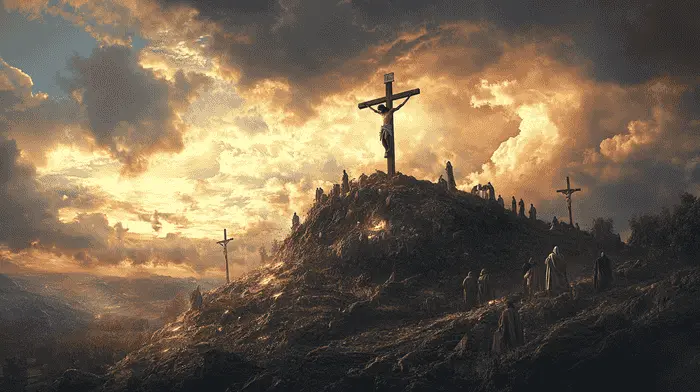
So the soldiers took charge of Jesus. Carrying his own cross, he went out to the place of the Skull (which in Aramaic is called Golgotha). There they crucified him, and with him two others—one on each side and Jesus in the middle.
Pilate had a notice prepared and fastened to the cross. It read: Jesus of Nazareth, the king of the jews. Many of the Jews read this sign, for the place where Jesus was crucified was near the city, and the sign was written in Aramaic, Latin and Greek. The chief priests of the Jews protested to Pilate, “Do not write ‘The King of the Jews,’ but that this man claimed to be king of the Jews.”
Pilate answered, “What I have written, I have written.”
When the soldiers crucified Jesus, they took his clothes, dividing them into four shares, one for each of them, with the undergarment remaining. This garment was seamless, woven in one piece from top to bottom.
“Let’s not tear it,” they said to one another. “Let’s decide by lot who will get it.”
This happened that the scripture might be fulfilled that said,
“They divided my clothes among them
and cast lots for my garment.”
So this is what the soldiers did.
Near the cross of Jesus stood his mother, his mother’s sister, Mary the wife of Clopas, and Mary Magdalene. When Jesus saw his mother there, and the disciple whom he loved standing nearby, he said to her, “Woman, here is your son,” and to the disciple, “Here is your mother.” From that time on, this disciple took her into his home.
The Death of Jesus
Later, knowing that everything had now been finished, and so that Scripture would be fulfilled, Jesus said, “I am thirsty.” A jar of wine vinegar was there, so they soaked a sponge in it, put the sponge on a stalk of the hyssop plant, and lifted it to Jesus’ lips. When he had received the drink, Jesus said, “It is finished.” With that, he bowed his head and gave up his spirit.
Reflection:
Today we have turn to scripture which speaks of the final hours of our Lord’s earthly ministry. John 18:1 through 19:30 is not just history; it is a mirror. In these verses we watch a mob, a governor, and a religious elite do three things that people still do today. They try to shackle the Way because His way is not their way. They question Truth because lies are easier to live with. And they kill Life rather than submit their own lives to God’s will. Let’s walk through the garden, the palace, and the cross together, and ask the Holy Spirit to show us where we might be doing the very same things.
First: They tried to shackle the Way—because His way was not their way.
John 18 opens in the Kidron Valley, “across the brook,” where Jesus has often met with His disciples. But this night is different. A detachment of soldiers, temple police, and Judas arrive with lanterns, torches, and weapons—like they’re hunting a dangerous criminal. The irony is thick. They are coming for the Light of the world with lanterns. They are arresting the Prince of Peace with swords.
Jesus steps forward and asks a simple question: “Whom do you seek?” (v. 4). They answer, “Jesus of Nazareth.” And when He replies, “I am he,” the Bible says they drew back and fell to the ground (v. 6). The very name of God—I AM—knocks trained soldiers flat. Yet what do they do next? They bind Him. They put chains on the hands that had healed the blind and raised the dead. They shackle the Way.
Why? Because Jesus refused to be the Messiah they wanted. They wanted a king who would drive out Rome with an army. Jesus came to drive sin out of the human heart with a cross. Their way was power; His way was surrender. Their way was revenge; His way was forgiveness. So they did what people still do—they tried to handcuff God to their own agenda.
How often do we do the same? We say we want God’s will… as long as it looks like our will. We sing “I surrender all” but secretly add footnotes: “except my career… except my politics… except my comfort.” We try to shackle the Way because the Way is narrow and the world is wide. But Jesus will not be bound by our preferences. He is the Way, whether we like it or not.
Second: They questioned Truth—because lies were easier to believe.
Now they drag Jesus to Annas, then Caiaphas, then to the Roman governor Pilate. In John 18:33 Pilate asks, “Are you the King of the Jews?” Jesus answers with a question of His own: “Do you say this of your own accord, or did others say it to you?” (v. 34). In other words, “Are you seeking truth, or just repeating the party line?”
Pilate’s response has echoed through history: “What is truth?” (v. 38). He says it with a shrug, then walks away. He doesn’t wait for an answer. He doesn’t want one. The religious leaders had already fed the crowd a lie—that Jesus was a threat to Caesar. The crowd preferred Barabbas, a known insurrectionist and murderer, over the sinless Son of God. Why? Because the lie let them stay comfortable. The lie let them keep their power. The lie let them avoid the cost of following Truth.
Friends, we live in a world that still shrugs and asks, “What is truth?”—then scrolls past it for whatever feels good. We question absolute Truth because absolute Truth demands absolute surrender. It’s easier to believe the lie that “my truth” is enough. It’s easier to believe the lie that success matters more than holiness. It’s easier to believe the lie that I can have Jesus and the world.
But Jesus told Pilate, “Everyone who is of the truth listens to my voice” (v. 37). The question is not “What is truth?” The question is “Are you seeking God’s truth. And when you hear it, when you find it, will you listen?” Will you stop questioning long enough to obey?
Third: They killed Life—rather than submit their own lives to God’s will.
By chapter 19 the pressure has mounted. Pilate finds no guilt in Jesus—three times he declares it. Yet the crowd shouts, “Crucify him! Crucify him!” (19:6, 15). When Pilate tries one last time—“Shall I crucify your King?”—they answer with blasphemy: “We have no king but Caesar!” (v. 15). They nailed the Author of Life to a Roman cross rather than bend their knee to God’s will. They preferred a dead Messiah to a living Lord. They preferred their own kingdom to the kingdom of heaven. And in one of the most haunting moments in Scripture, they chose Barabbas—literally “son of the father”—over the true Son of the Father.
But watch Jesus. Even as they kill Life, He submits. He carries His own cross. He refuses the drugged wine so He can feel every ounce of the cost. And at the end, with blood and breath failing, He declares, “It is finished” (19:30). The work of redemption is complete. The Father’s will is done. And thank Lord of Heaven He did.
Here is the terrible truth: every time we refuse to submit our lives to God, we are choosing crucifixion over surrender. We “kill” the life God wants to give us—joy, peace, purpose—because we would rather keep control. We would rather stay dead in our sins than be made alive in Christ. So, what does this passage demand of us today?
- Stop shackling the Way. Let Jesus be Lord on His terms, not yours. His way may journey through suffering, but it leads to glory. Trust the Great I AM who word’s spin reality into being.
- Stop questioning Truth. The Truth is standing right in front of you—Jesus Christ. Open the Word, open your ears, and say, “Speak, Lord, your servant is listening.”
- Stop killing Life. Lay down your rights, your grudges, your secret sins. Submit your will to the Father’s will. Because the same Jesus who was shackled, questioned, and killed, he rose again, because He Is, He is Life. Alive today is Your God—and He offers you resurrection life if you will only surrender.
My friends, the garden is still here. The choice is still here. Will you arrest Jesus and keep Him at a distance? Or will you fall at His feet and say, “Lord You are the Way, the Truth and the Life, Your will be done not mine.”
Let us pray….
Heavenly Father, forgive us for every time we have tried to bind Your Son to our plans, questioned Your Word because it cost too much, or chosen death over life. By Your Spirit, break every chain, silence every lie, and raise us to new life in Christ. In the name of the Way, the Truth, and the Life—Jesus our Lord—amen. Go in peace. The cross is empty. The tomb is empty. And the Way is open. Follow Him.
Homework:
Hold the reality of Good Friday with mourning and hope. Know Easter is coming.
If you need help on this reflective journey email: minister@mountainviewunited.ca
Closing Prayer:
May the God of steadfast love, who gave his only Son to be lifted up for our salvation, bless you and keep you. May the face of Christ, who said “It is finished”, shine upon you with mercy and grace. May the Spirit of truth, whom Jesus came to testify, lead you in paths of peace and justice all your days. Amen.
Thank you for joining us this week. If you have any thoughts, feelings, or prayers, feel free to leave them in the comment section below. Please be respectful of others’ posts and make room for all those joining us.
Leave a Reply